
The Song That Raised Me Up
- Tracey Kida
- Feb 4
- 4 min read

Updated: Feb 24
Isn’t it funny how sometimes the very person you thought was standing in your way ends up showing you the path you were meant to walk all along?
For me, that lesson came wrapped in a choral score and a bit of teenage indignation. 'You Raise Me Up' by Josh Groban became the bridge between the singer I thought I was and the musician I was becoming — a lesson I didn’t want, but one that shaped me as a performer, songwriter, and educator.
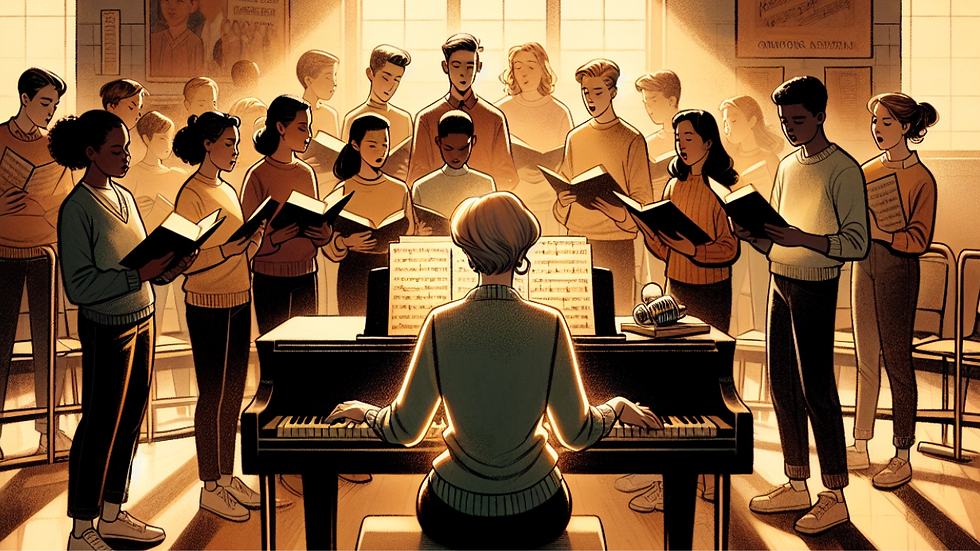
In high school, I sang soprano in both Show Choir and A Cappella Choir — confident, steady, and strong. My background in band gave me the advantage of reading music fluently, playing basic piano, and holding pitch with precision. Those skills made me a natural leader in the soprano section. I was trusted to run rehearsals in the practice room — yet somehow, my teacher never seemed to trust me as a soloist. Time and again, I watched opportunities pass to others, even when I knew I was ready.
Our Show Choir was large — full of energy and balance, with enough singers to separate the men and women for special pieces. That meant our girls’ group could explore lush SSA and even SSAA voicings — rich harmonies layered like sunlight through stained glass. I usually sang Soprano 1, but I had a good ear, so I sometimes covered Soprano 2 when harmonies needed extra support.
Then came senior year — and the song that changed everything.
We were preparing What’ll I Do by Irving Berlin, a hauntingly beautiful ballad arranged for SSAA voices. The harmonies shimmered and stretched, as if testing our balance. During that first rehearsal, I was intrigued but not particularly moved — until the moment my teacher announced part assignments.
She placed me on Alto 2.
The shock hit hard. I was a soprano—a leader among sopranos. I had never sung alto, and certainly not the lowest alto part. My emotions tangled — confusion, hurt, even a little fear. I pleaded my case, but my teacher stood firm. She told me she believed I could handle it.
So, I did.
It wasn’t easy. Those low notes felt foreign at first, like stepping onto a strange path in the dark. But within weeks, my ear adjusted, and something remarkable happened: I began to love it. The harmonies that once felt distant now pulled me in. I discovered that my voice belonged there. And though I returned to soprano parts for the rest of the year, something inside me had shifted.
When I entered college as a music education major, that quiet lesson came calling again.
My audition for Chorale had been delayed a semester, and when I finally arrived, the soprano section was overflowing. The professor, impressed by my range and reading skills, invited me to sing alto instead. The section, he said, needed strength — and I could be that strength.
I said yes.
Within a month, I found myself leading the alto section, helping blend tones and shape phrases. That experience led to others — conducting a Renaissance madrigal choir, directing a Methodist church choir, and even co-founding a jazz ensemble. All of it, in some way, traced back to that moment in high school when my teacher had handed me an alto part I didn’t want.
Now, years later, I can say with certainty: I am an alto who can sing soprano — but I crave harmony.
Harmony, for me, is a kind of home.
As a young flute player, I had always played the melody — clear, singular, and shining. Later, when I switched to tenor saxophone, I found myself wrapped in the undercurrents — the rhythmic, grounding parts that made the melody soar. That shift changed how I listened. I began to hear the hidden threads — the way harmony holds the heart of a song together.
That same instinct lives in me as a singer. My ear naturally reaches for the inner lines — the notes that weave around the melody, supporting it, completing it. I no longer chase the spotlight; I chase the connection.
Years after college, I was invited back to celebrate my high school choral director’s retirement. Alumni were gathering to perform one last piece together. The song? You Raise Me Up — Josh Groban’s soaring anthem of strength and gratitude.
I smiled at the irony.
Relearning the piece, now from the alto line, I found myself reflecting on the woman who had once frustrated me so profoundly. I saw her lesson clearly now. She hadn’t demoted me — she had redirected me. She had seen something I couldn’t yet see.
That Alto 2 assignment had changed the shape of my voice — and my life.
Today, when I teach, I carry her legacy with me. Every time I guide a hesitant student toward their own strength — every time I encourage someone to step into a harmony they’ve never tried — I hear her voice reminding me that sometimes, the hardest lessons are simply the ones that take the longest to understand.
Because in the end, she was right.
She raised me up — just not in the way I expected.


Comments