
Inside the Sound of Christmas
- Tracey Kida
- Feb 4
- 4 min read

Updated: Feb 24
Every December, as the cold settles in and the year winds down, I reach for the same playlist—one I’ve built slowly over the years. These aren’t the typical Christmas songs that flood the radio airwaves. They’re quieter treasures, filled with memory and meaning. Songs that hold something sacred for me. Each year, I press play, and the music carries me back.
Some of the pieces that return to me most vividly are ones I first performed decades ago—during high school band and college Wind Symphony. More than 30 years later, I can still hear the scores in my head. I still conduct along, instinctively, as if I’m back in rehearsal or standing before the band. That same rush returns—the thrill of creating something beautiful with others. I can still feel the breath of the room, the weight of my instrument, the presence of the ensemble around me.
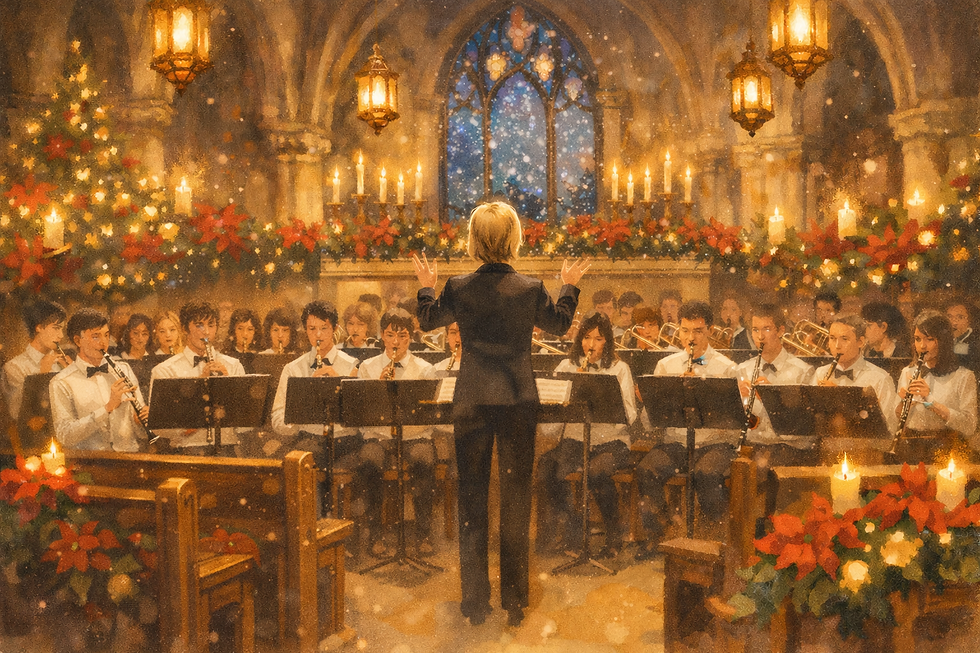
To tell this story, I have to take you back to a yearly tradition: the Westfield State Wind Symphony Christmas concert, held in the Greek Orthodox Church in Springfield.
It was always a full-day affair. The church was breathtaking—high, ornate arches stretching toward the heavens, gilded icons catching the light of flickering candles. The scent of incense lingered in the air, mingling with the glow of red and white poinsettias that lined the altar. The audience arrived in their holiday best, spanning generations. You could feel the sense of occasion, of reverence—for the season, for the music, for each other.
We were a large group, packed tightly between the pews and the altar, surrounded by stone and wood and sound. And oh, the sound. Those cathedral acoustics gave life to the music in a way no traditional auditorium ever could. The space sang with us.
Over the years, we played many holiday selections, but three pieces have never left me. Each one still lives in my bones.
Leroy Anderson’s Sleigh Ride and A Christmas Festival became beloved staples of our holiday concerts. I had first met Sleigh Ride in high school band, and by college it had become a seasonal tradition. A Christmas Festival joined the yearly lineup not long after.
They were both pure joy to play—bright, festive, challenging in all the right ways. As a tenor saxophone player, I rarely carried the melody, but the counterlines were clever, syncopated, and deeply satisfying. It was the kind of writing that made you feel like an essential thread in a beautiful tapestry. And as a conductor? Even more fun. There’s something deeply rewarding about leading those familiar motifs—hearing the echoes of “Joy to the World” and “Deck the Halls” swirling through the ensemble, perfectly stitched together.
There’s a moment in Sleigh Ride, near the end, when the trombones kick into a jazzy, brassy groove. They sat directly behind me, and when they let loose, our chairs would vibrate from the sheer force of their sound. It was electric. You could feel it in your ribs. That kind of energy—the shared pulse of live music—is something you don’t forget. You live inside it for a moment, and then carry it with you forever.
But the third piece… the third piece was something else entirely.
Russian Christmas Music by Alfred Reed wasn’t a yearly tradition. In fact, we only played it once. But I’ve never forgotten it. It wasn’t jolly or bright. It didn’t dance with sleigh bells or sparkle with familiar carols. It was somber. Sacred. Hauntingly beautiful.
Reed, an American composer, was commissioned in 1944 to write a piece based on Russian Christmas carols—a musical gesture meant to soften Russian-American tensions during World War II. What he created was something bold and cinematic, running nearly 15 minutes, unfolding in waves of sound and silence.
There were moments so soft they barely brushed the air, and others so grand the walls seemed to tremble. The timpani rolled like distant thunder. The melody would rise—strong, aching, proud—only to retreat again into whispers. The tubular bells joined the brass in a final fanfare that seemed to ring from the earth itself.
We performed it in that same cathedral. And when we reached the final chord—when the sound finally fell away—there was a moment of stillness so pure, so suspended in time, that no one moved. The echo lingered like breath held in a sacred room.
Afterward, our conductor said she might never program it again. Not because it wasn’t worthy—but because she couldn’t imagine it being more perfectly played. We had given it everything. And it had given something back.
I haven’t sat in an ensemble in many years. Life has taken me down other winding roads. But those moments—those songs—are still with me.
Performing music with others isn’t just about notes and rhythms. It’s about learning to listen deeply. To give and receive. To shape something ephemeral with your whole body. It’s about community. And presence. And magic.
I hope that today’s young musicians get to feel that. I hope they sit in rooms filled with light and harmony and laughter. I hope they find their own pieces—the ones that stay with them long after the concert ends.
Because there is nothing quite like being inside the music.
And once you’ve been there… you never really leave.


Comments